

After three years in motion, the THRILL consortium is pleased to report on its most recent achievements and highlights, including four new publications and several training events. In the final year of the project, all work packages make good progress towards the project objective: delivering new schemes and devices for pushing forward the limits of research infrastructures of European relevance and ESFRI landmarks.
High-energy high-repetition-rate amplification
- Amplitude
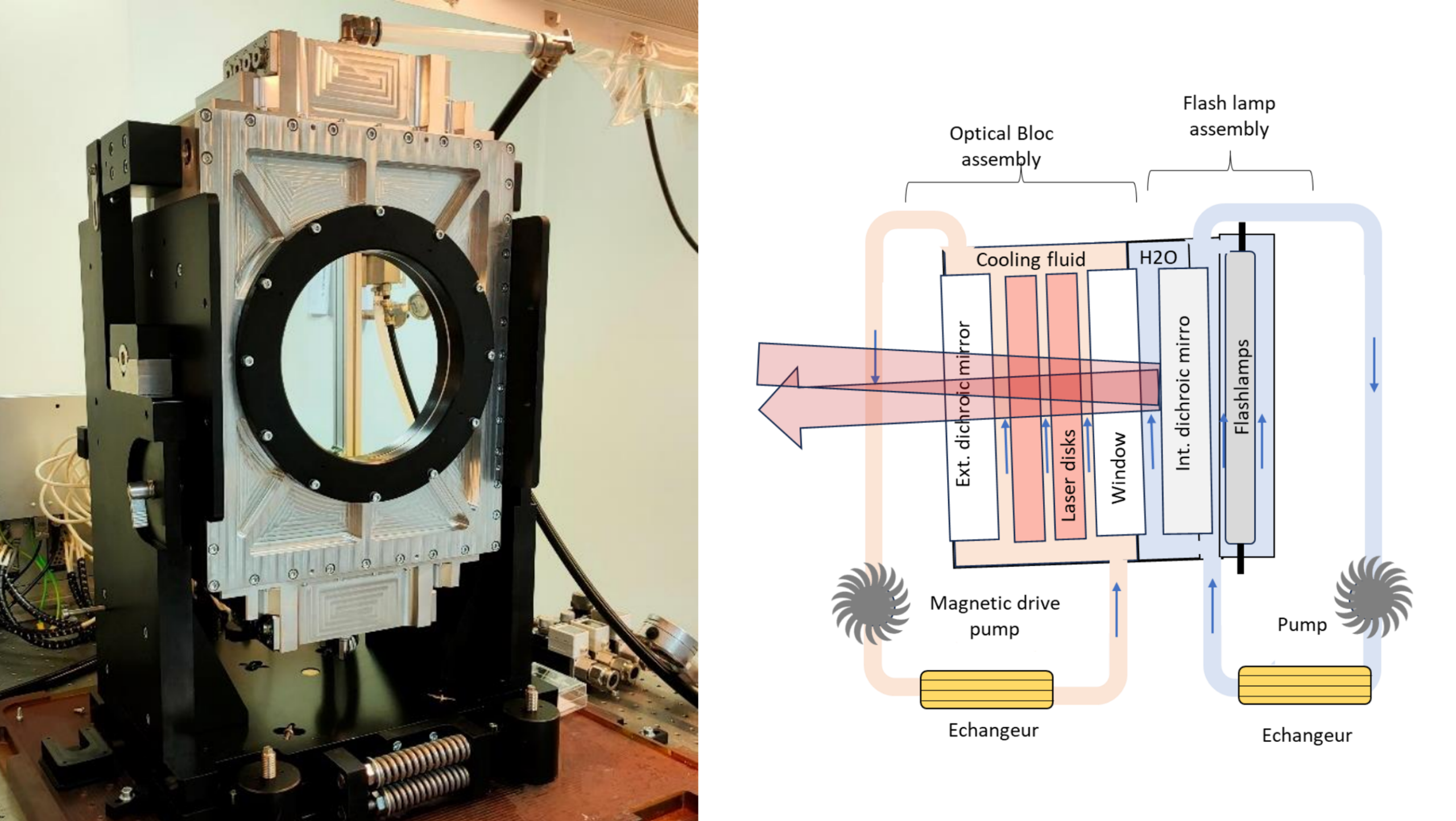
Enabling high-repetition rate kJ beams: Scaling of the PAMDAM flashlamp-pumped Nd:glass slab amplifier to a large diameter of 170 mm was demonstrated, paving the way towards shot-per-minute kJ beams. The amplifier module was tested with different cooling fluids to be used for thermal management and energy extraction optimization.
- GSI
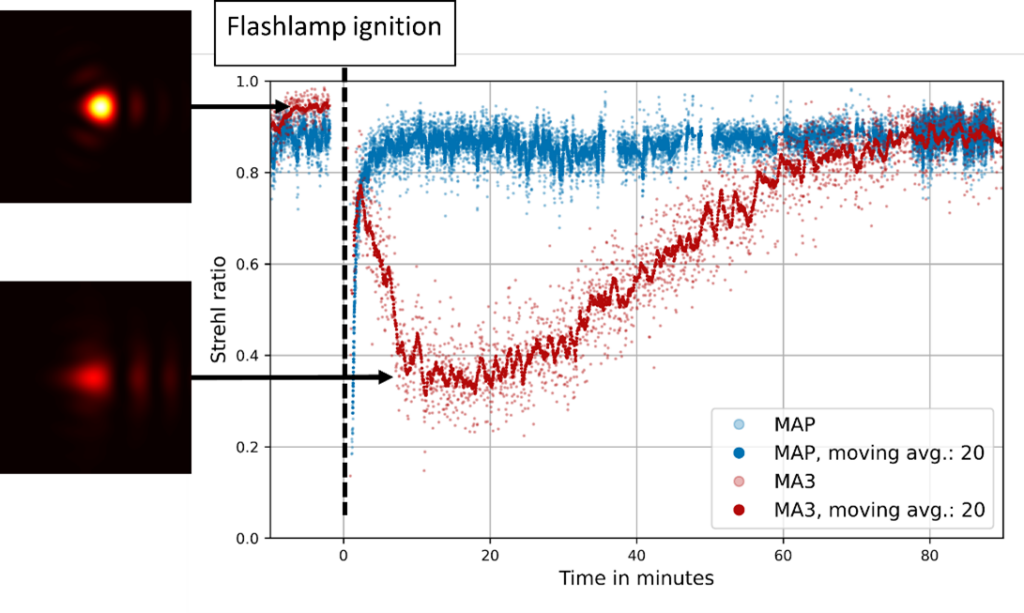
The effect of water-cooled flashlamps was demonstrated in the 31-cm-aperture PHELIX slab amplifier module at GSI. The time it takes for the wavefront distortions caused by the flashlamp heat in the amplifier volume to return to the pre-shot value is significantly reduced by the active cooling.
- LULI
After successful demonstration of passive beam combining on the several Joule energy scale, active beam combining has been studied at LULI. Here the wavefront-effects of the flashlamp flash have been evaluated and compensation measures designed. For an experimental validation a system design was proposed and modelled, using the implementation of a full laser chain beam propagation and energy extraction model based on the temporal Frantz Nodvik equation. Currently, the procurement and setting up of a system comprising two Ф45 laser heads is underway.
ITO coated Pockels cells (HZDR)
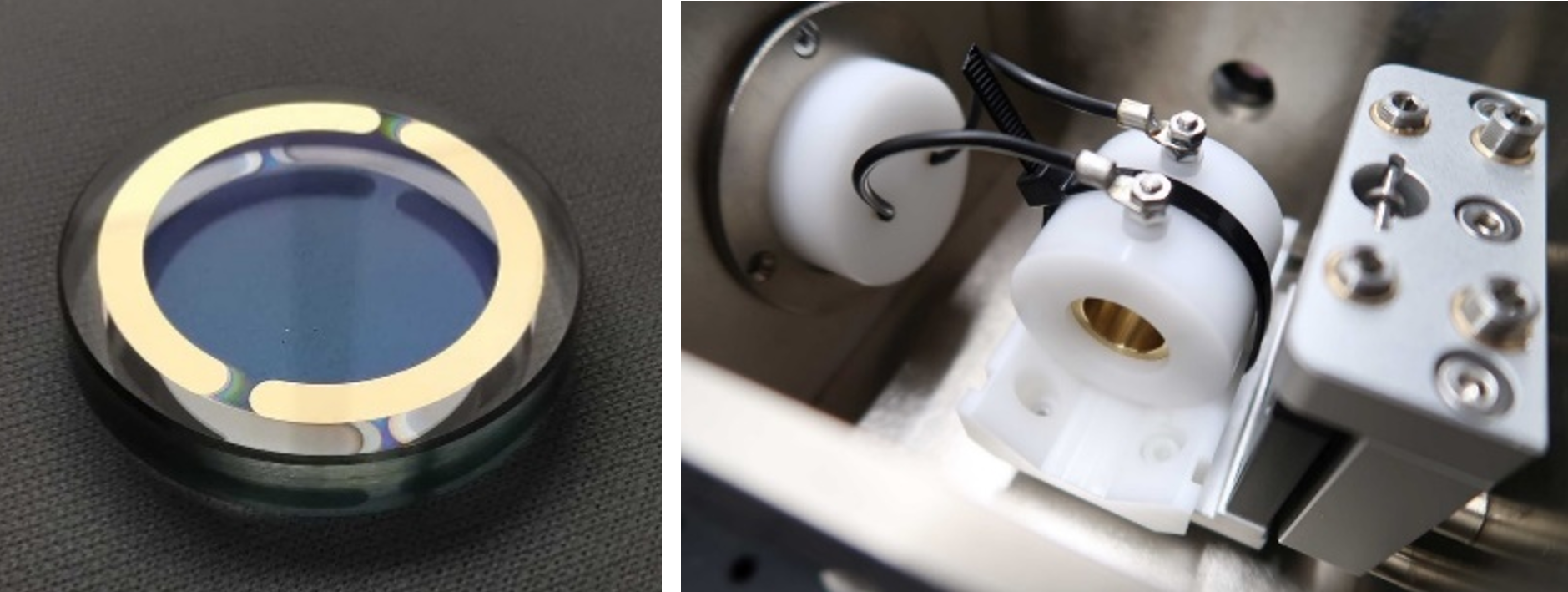
With the goal of developing large-aperture electro-optic modulators (e.g. Pockels cells for optical switching), progress has been made on applying indium tin oxide (ITO) coatings. While laser induced damage threshold measurements at 800 nm and 1064 nm show promising results, a number of promising complex coatings have been identified for next step demonstration on KDP. A V-coated operational Pockels cell demonstrator has been tested successfully showing the capability of the principle.
High-energy beam transport (LULI, GSI)
- Advancing Adaptive Optics (January 2025): The THRILL workshop on adaptive optics integration brought together leading scientists to address critical challenges in high-power laser control.
- Real-time adaptive optics (RTAO) system at Apollon was finalized and first promising tests were performed.
- An interdisciplinary collaboration was established on the CACAO software, initially developed for astronomy. In order to start enabling to the high-power-laser community to use the adapted version of the CACAO software, an on-site training course was hosted by GSI in October 2025 with participants from several members of the consortium.
- THRILL Postdoc Jonas Ohland has been awarded BMFTR grant to launch young investigator group “ALADIN”.
Optics for high-energy lasers (ELI)
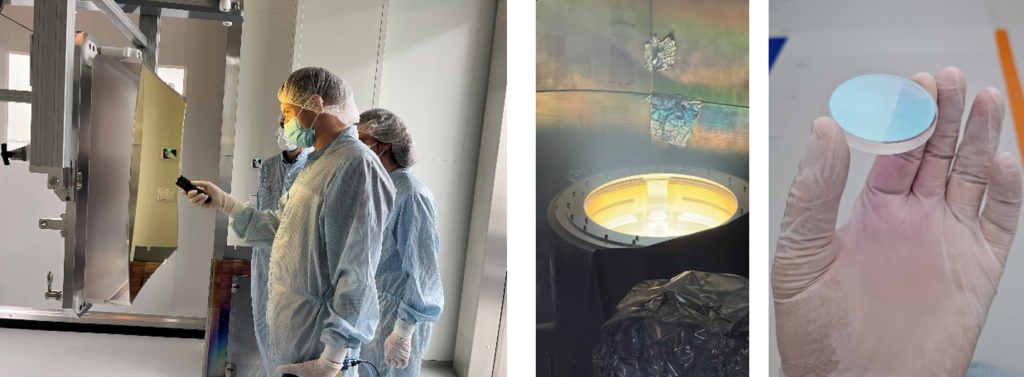
ELIAS coating system reached state of the art (<0.5 %) thickness uniformity over 1.2 m aperture during the development of high damage threshold MLD coatings. Ultrafast gold HR coatings were developed and coated on L4 ATON compressed beam transport mirrors. This enabled the successful commissioning of the laser chain at 5 PW peak power. MLD coating development assisted by a 10 kW plasma source prototype was started.
Simulation software development: OPOSSUM (GSI)
- OPOSSUM workshop showcases future of open-source optical simulation – On 4th June 2025 an online workshop was held to advertise the OPOSSUM status and envisaged capabilities, which confirmed that there is considerable interest in the community.
- The OPOSSUM software (v0.6.0) now incorporates the first real system applications: ghost focus analysis, handling of reflective gratings and parabolic mirrors.
- Outlook: the next goal is to establish a graphical user interface to enable usability.
CDR for a laser system at FAIR
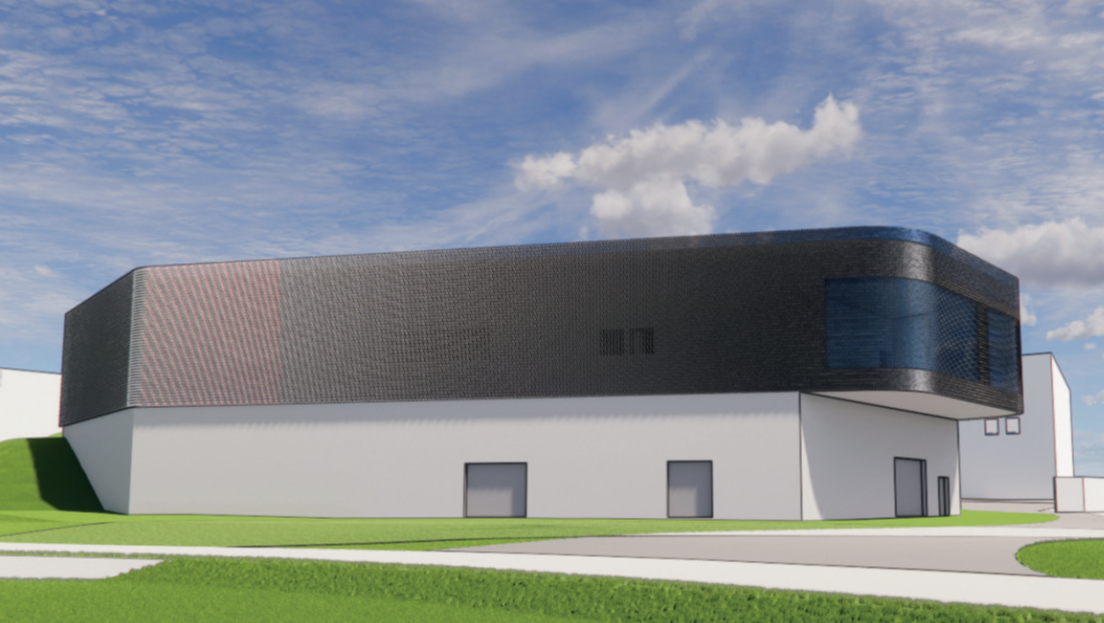
A conceptual design for a laser building on the FAIR site next to the APPA experimental area has been completed by contracted architects (FAIR). A 3D model of the building has been added to the planning database of the FAIR facility to reserve the space needed for the building.
2025 in numbers



Outlook
In mid-April, the THRILL consortium will gather in Paris, France, for our next meeting.
The next THRILL Summer School will take place in Hirschegg, Austria, from 7-13 June 2026. Lectures and directed activities will focus on Applications of High Energy / High Power Lasers.
We look forward to the final year of our project to continue to work on advancing technology in the field of high-energy high-repetition-rate lasers and train a highly skilled workforce for tomorrow’s challenges in research infrastructures and industry!
Subscribe to our newsletter and follow us on LinkedIn to learn more about our work at THRILL, and stay updated on our advances!
