

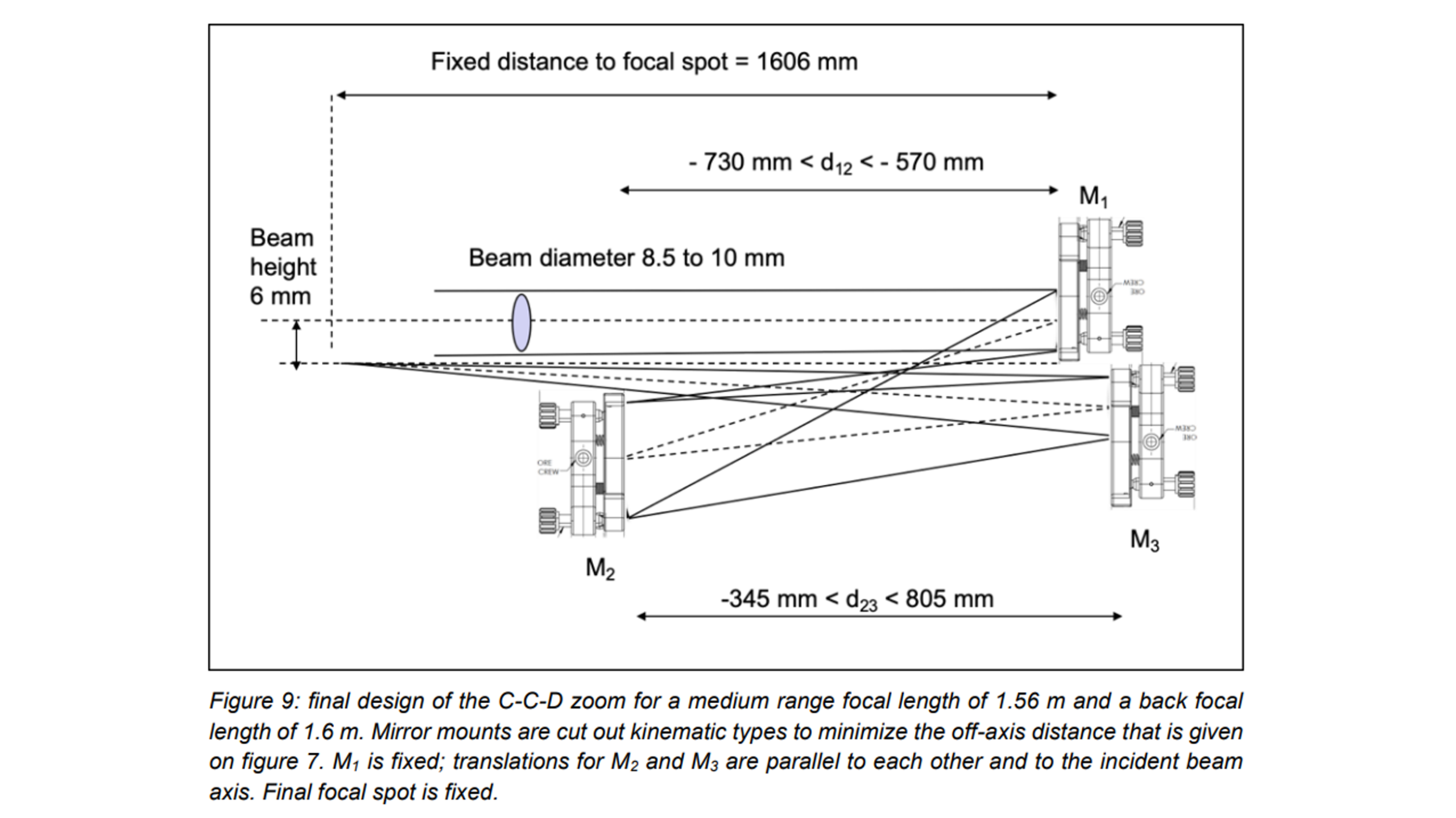
As part of WP5 of THRILL on advanced laser beam control, the deliverable D5.3: Design of an adjustable beam focusing system for PW lasers has been published. This study focuses on the design and validation of a three-mirror telescopic zoom system using spherical mirrors to meet the stringent optical requirements for laser-driven electron acceleration at petawatt-class laser facilities.
The primary objective is to vary the focal length continuously without displacing the final focal spot, while respecting laser-induced damage thresholds that prohibit beam compression. Multiple optical configurations were analyzed, and a 1/5-scale mock-up constructed at the Apollon facility enabled validating the design. Experimental measurements of aberrations closely matched theoretical predictions, confirming the accuracy and reliability of the optical model.
Key challenges addressed in the design include:
- Maintaining high beam quality with minimal spherical aberration across the zoom range.
- Avoiding central beam obscuration by adopting off-axis mirror configurations.
- Ensuring mechanical feasibility in a vacuum environment with large-diameter laser beams.
- A step-by-step geometrical design method was developed to evaluate both on-axis and offaxis systems, adhering to the following constraints:
- No beam obscuration at any zoom position.
- A real final image over the entire zoom range.
- Minimum mirror beam size maintained (≥95% of the incoming beam).
- Fixed final focal spot position throughout zooming.
- Numerical aperture maintained between f/15 and f/20.
Among the eight possible mirror arrangements (combinations of converging and diverging mirrors), four configurations were found viable. The C-C-D (convergent-convergent-divergent) setup was identified as the optimal solution, offering a balance of compactness, low aberration, and mechanical practicality.
Three reduced-scale systems were designed, built, and tested:
- D-C-D: Very compact, but with limited zoom range and mechanical complexity.
- D-C-C: Offers multiple aberration minimization points, but is excessively long.
- C-C-D: Best overall performance, allowing compact implementation with excellent beam quality.
The C-C-D configuration, when implemented in an off-axis layout, successfully avoids obscuration while maintaining optical performance. In conclusion, this work demonstrates that reflective zoom systems using spherical mirrors can be precisely engineered through geometrical analysis to deliver high-quality, variable-focus laser beams suitable for advanced applications like laser-plasma electron acceleration, all while operating within laser damage thresholds and mechanical constraints.
The deliverable is available for download: D5.3: Design of an adjustable beam focusing system for PW lasers
