

“Adaptive optics showed me how physics, computation, and engineering can merge – now we’re taking that integration to the next level”
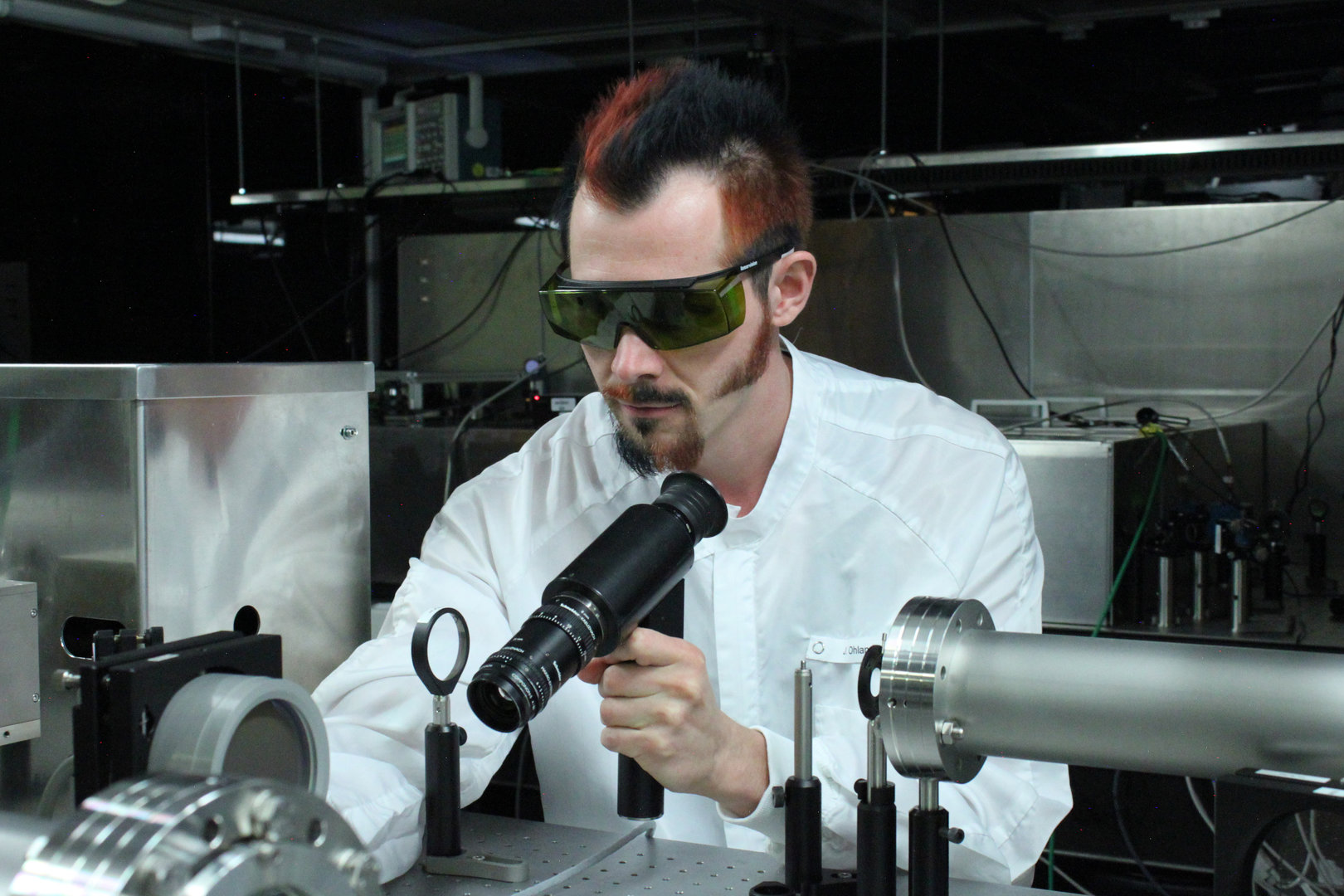
Meet Jonas Ohland, a laser physicist at GSI/FAIR, who is exploring how to make operating high-power lasers simpler, more stable and much more scalable with his newly funded project ALADIN.
Please introduce yourself.
Hi! My name is Jonas Ohland, I’m a laser physicist at GSI/FAIR working on beam control and adaptive optics for high-intensity lasers. After studying and completing my PhD at TU Darmstadt/GSI on the PHELIX laser, I moved to work on the Apollon laser in France as part of the THRILL project, and returned to GSI in 2024. Since mid-2025, I’ve been leading the young investigator group ALADIN, where we focus on control architectures for next-generation fusion lasers. My work sits somewhere between physics and engineering – getting lasers to behave reliably under extremely tough conditions.
You have recently been awarded a BMFTR grant for your project ALADIN. Can you tell us more about it?
ALADIN is short for “Adaptive Laser Architecture Development and INtegration” – it is a project about one core idea: if future fusion power plants are to rely on high-energy lasers firing rapidly and with high precision, the beam control must be equally scalable. We’re developing an “Adaptive Laser Architecture” that integrates sensing, correction and automation directly into the laser infrastructure. The goal is to create a control framework that can keep many lasers stable at once – something the field will urgently need.
The challenge is that, while the individual parts of these systems exist, there’s no solution yet to make them work together. We’re building testbeds, trying out control concepts, and figuring out how to combine optics, computation and automation into one coherent architecture. Everyone in the group is hands-on right now, getting the experimental foundation in place.
What inspired you to pursue this particular research topic?
Part of it is practical: beam control is a bottleneck for future fusion lasers, and solving this issue would have a very direct impact. However, there’s also a broader motivation – it’s an area where many disciplines meet. My work in THRILL, especially on real-time adaptive optics at Apollon, made that very clear. Once you see how different communities use similar tools, you realise the need for a framework that can bring these things together.
“Research means working right at the edge of what you know – otherwise it wouldn’t be research”
What are the expected outcomes or long-term impacts of your research?
If ALADIN succeeds, operating high-power lasers – including fusion drivers – will become simpler, more stable and much more scalable. However, I expect spillover effects extending beyond fusion, including applications in industrial lasers and scientific facilities, anywhere where precise control of high-energy beams is required. We’re also training people who are comfortable working across the fields of optics, control theory, computation and diagnostics. This combination of skills will remain relevant for a long time.
As a Junior Research Group Leader, how do you balance research, leadership, and mentoring responsibilities?
Right now, the group is young and everything starts with practical work. We’re building our setups at PHELIX, getting our testbeds running, and learning what the architecture should look like. So, for now, “leadership” is mostly about making sure everyone has a clear path forward and enough space to explore.
In the long run, I want the team to be autonomous with clear interfaces – a group where everyone owns part of the system and feels responsible for it.
What are your strategies for building an effective and motivated research group?
We’re establishing our engineering and coding standards as we go, and that’s part of the research itself. Early on, I encourage people to take ownership of small yet meaningful systems so they can shape the direction of the project. A shared technical culture evolves naturally when everyone contributes to building the foundations.
“The quality of your collaborations may turn out to matter more than your individual skills.”
What was your biggest challenge of working in science so far?
The transition from being a well-shielded PhD student or postdoc to suddenly needing full connections to HR, procurement, the grant office and so on was much sharper than expected. The status itself is manageable – it’s the sudden change that’s challenging. You have to adapt quickly while also continuing with your research.
Your advice for other young researchers?
Research means working right at the edge of what you know – otherwise it wouldn’t be research. Follow what genuinely motivates you, but stay aware of the skills you’re missing and actively train them, whether through summer schools, software courses, or just honest conversations with colleagues. And in the long run, the quality of your collaborations may turn out to matter even more than your individual skills.
Last question: What’s currently your favorite tech topic and why?
I’ve always loved adaptive optics for the way it merges physics, computation and engineering into a single fast feedback loop. But what really excites me now is taking the next step: integrating multiple controls into a larger framework capable of handling complex systems. That’s where real progress for fusion lasers will happen.
Thank you for the interview, Jonas!
Subscribe to our newsletter and follow us on LinkedIn to learn more about our work at THRILL, and stay updated on our advances!
Title image by Johannes Hornung, GSI/FAIR
