

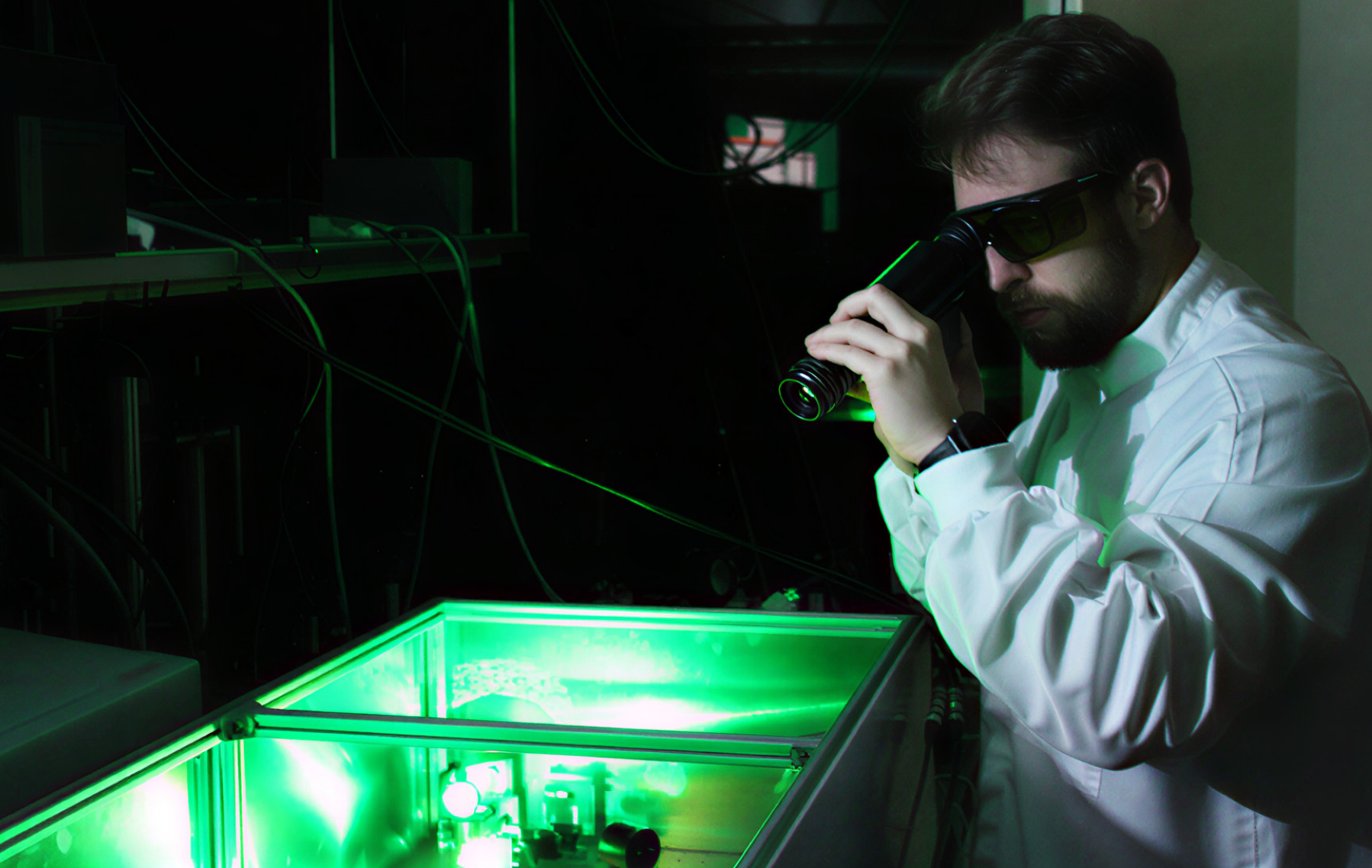
“What motivates me most is the combination of scientific challenge, practical relevance, and the opportunity to contribute something useful to the field”
Meet Yannik Zobus, a laser physicist at GSI, who is developing a holistic simulation framework, essentially a digital twin for future fusion laser systems, in his newly funded project LASE-FUSE.
Hi Yannik, please introduce yourself.
Hey there! My name is Yannik Zobus, and I’m a laser physicist at GSI Helmholtzzentrum für Schwerionenforschung, working on the PHELIX laser as well as laser modeling and fusion-relevant laser technologies.
My background is in high-contrast ultrafast laser development, where I worked on advanced frontend systems for the PHELIX and PENELOPE lasers during my PhD. Over the last years, my research gradually shifted toward holistic laser system modeling and fusion applications, especially within the THRILL project.
Today, my work combines laser physics, software development, and system engineering. The most fascinating aspect for me is understanding how extremely complex laser systems behave as an integrated whole, rather than just as a collection of isolated components. This perspective eventually led to the creation of the junior research group LASE-FUSE, which I’ve been leading since May 2026, funded by the German BMFTR (Federal Ministry of Research, Technology and Space).
“The most fascinating aspect for me is understanding how extremely complex laser systems behave as an integrated whole, rather than just as a collection of isolated components.”
Can you tell us more about your new project LASE-FUSE?
LASE-FUSE stands for “LAser Simulation for Enhanced FUSion Efficiency.” At its core, the project is about developing a holistic simulation framework. Essentially, a digital twin for future fusion laser systems.
These lasers will need to operate with unprecedented stability, precision, and efficiency. At the same time, new concepts for improving laser-to-target coupling still need to be tested across the full system, from pulse generation to amplification and beam transport. Yet there is currently no open, integrated simulation platform that can model all of this end to end.
That is exactly the gap LASE-FUSE aims to close.
We are developing an open simulation ecosystem that combines holistic laser modeling with advanced fusion-relevant concepts such as spatio-temporal smoothing using partially incoherent pulses, focal zooming, and virtual diagnostics. Ultimately, the goal is to accelerate the development of future fusion laser facilities and make innovation in this field faster and more accessible.
What inspired you to pursue this particular research topic?
It grew naturally out of my previous work on high-power laser systems at PHELIX and within the THRILL project, where we started developing OPOSSUM, an open-source framework for holistic laser simulation.
There, it became clear how complex modern fusion laser facilities really are. Not just collections of optical components, but tightly coupled systems where every detail matters. What motivates me most is the combination of scientific challenge, practical relevance, and the opportunity to contribute something useful to the field while also creating accessible tools for others working in this area.
“Ultimately, the goal is to accelerate the development of future fusion laser facilities and make innovation in this field faster and more accessible.”
What are your strategies for building an effective and motivated research group?
I think people are usually most motivated when they understand how their work contributes to a larger goal and when they can take real responsibility. I want members of the group to feel that they are not just working on isolated tasks, but contributing to a larger system with long-term impact.
Because the project combines physics, software development, and engineering, close collaboration across different skill sets is essential. I try to create an environment where people can learn from each other and where interdisciplinary thinking is encouraged from the beginning.
In the long term, I would like the group to be a place where people can work independently while still working toward a common vision.
What was your biggest challenge of working in science so far?
Probably learning how to deal with increasing complexity while still staying focused on the actual scientific questions.
During the transition from PhD to postdoc and even more toward leading projects, I realized that research involves much more than the science itself. You suddenly have to think about coordination, infrastructure, collaborations, funding, and communication across very different areas.
I also learned that large projects require patience. Often, solving one problem reveals three new ones, but that is also what makes the work exciting.
What’s currently your favorite tech topic and why?
It may not be a surprise, but my current favorite tech topic is inertial fusion energy. Even though the basic principles of inertial confinement fusion have already been demonstrated, there is still a lot to do and many challenges to overcome – from laser development and targetry to diagnostics and tritium breeding. What makes the field especially exciting right now is how quickly it is moving and evolving.
For me personally, the most exciting part is the modeling of high-energy laser systems and the development of new ideas and approaches for laser technology, which has fascinated me since the beginning of my studies.
“The goal is not only to advance fusion laser technology, but also to create something lasting: a strong knowledge base, an active community, and a platform that future generations can build on.”
What are the expected outcomes and long-term impacts of your research?
In the short term, LASE-FUSE aims to provide a robust and open simulation platform for fusion-relevant laser systems, together with new concepts for improving laser efficiency and stability.
In the longer term, I hope the project helps build a sustainable open-science community around holistic laser simulation. One where researchers, institutes, and industry can collaborate more closely, share tools, and develop ideas together.
Ultimately, the goal is not only to advance fusion laser technology, but also to create something lasting: a strong knowledge base, an active community, and a platform that future generations can build on. I also hope it helps inspire the next generation by showing that this is an exciting field with real scientific and technological potential.
Thank you for the interview, Yannik!
__
Subscribe to our newsletter and follow us on LinkedIn to learn more about our work at THRILL, and stay updated on our advances!
Images: J. Hornung, GSI/FAIR, K. Geißler
