

In October 2026, the THRILL project published four new deliverables highlighting significant progress in laser amplification, adaptive optics, machine learning-based beam stabilisation and advanced optical coatings. The results address key technological challenges in developing more powerful, reliable and efficient high-energy laser systems. All reports and further information are available on the THRILL deliverables page.
D4.3: Report on concept for high-energy high-rep amplifier
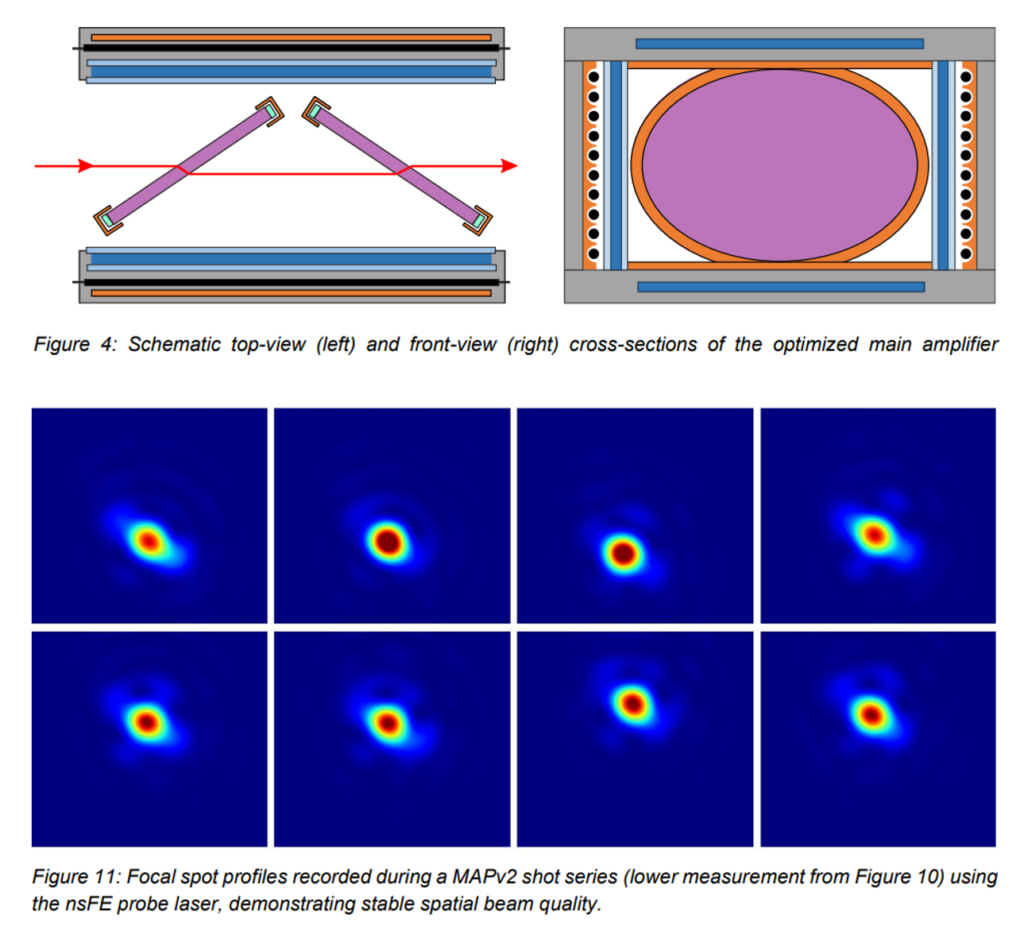
Researchers at GSI have developed and tested new actively cooled amplifier concepts for the PHELIX high-energy laser. The aim was to significantly reduce the time needed for the amplifier to recover between laser shots while maintaining its optical performance and efficiency.
An initial water-cooled prototype reduced the thermal recovery time from 90 minutes to just 5–10 minutes, but at the cost of a nearly 30% reduction in Nd:glass pumping efficiency. Two improved designs were subsequently developed to address this limitation.
The most successful design, MAPv2, restored the pumping efficiency to the level of conventional PHELIX amplifiers while retaining the much faster thermal recovery. These results represent an important step towards operating high-energy laser systems at higher repetition rates.
D5.4: Report describing an integrated adaptive optics software architecture
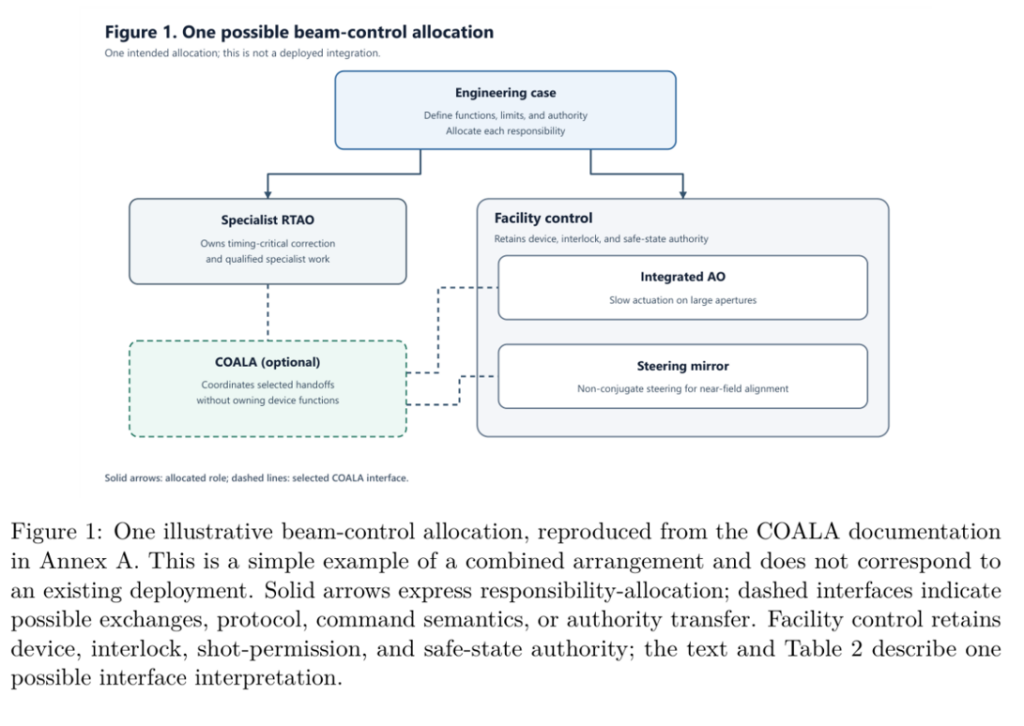
Adaptive Optics (AO) systems in high-energy lasers span from semi-static optimization to timingcritical real-time stabilization. Such systems are often found in the form of self-sufficient specialist AO systems, which run in parallel to the facility-wide control systems. A conditional integration problem arises when an AO procedure needs optical context, information, permitted action or operational authority across their usual boundaries. This motivates a product-independent software architecture that allocates responsibilities, identifies the needed context and interfaces, and permits only the control relationships justified by the selected AO integration use case.
Researchers from GSI and École Polytechnique/LULI have developed a rule-based framework for such a software system. A suitable architecture is expressed as four proposed broadly applicable requirements: qualified ownership, physically meaningful control context, bounded integration interfaces, and caseappropriate control relationships.
Their completeness and representative cross-facility generality remain unvalidated as specialistnative and facility-native solutions remain legitimate under feasible circumstances. Where neither is suitable, the researchers propose the COntroller for Adaptive Laser Architecture (COALA) approach: an optional framework for building a subsystem with an assigned coordination role between the expert subsystems and the facility-control system. They illustrate this approach via a combined real-time AO steering + semi-static integrated-AO arrangement, while using an exploratory COALA implementation to provide insight and evidence to this approach.
The work was carried out in collaboration with the SCExAO team of the Subaru Telescope in Hawaii, demonstrating valuable synergies between adaptive optics applications in high-power laser research and astronomy.
The full report is also available on Zenodo: https://zenodo.org/records/23691048
D5.5: Report describing an integrated adaptive optics software architecture
Researchers at Helmholtz-Zentrum Dresden-Rossendorf (HZDR) have released an open-source machine learning software designed to improve beam stability for the PHELIX laser system at GSI.
The software implements a hybrid predictive-feedback stabilisation scheme for the PHELIX laser system at GSI. A patch-based multilayer perceptron (Patch-MLP) forecasts short-term horizontal and vertical beam-pointing errors from diagnostic time series, and a proportional-integral-derivative (PID) controller converts the predictions into correction commands for an upstream tip-tilt mirror.
This pre-compensation offsets the latency of a conventional feedback loop.
The report describes the delivered software, the beam pointing analysis, and the prediction and compensation system modelling. Over a ten-hour simulated test, the predictive controller reduced residual jitter by approximately 17-20 % in RMS, 11-13 % in peak-to-valley and 18-21 % in FWHM compared with a conventional PID controller. The controller remained stable without drift across 110 one-minute test segments. The code, paper and data are openly available under a Creative Commons Attribution 4.0 International licence.
D6.1: Report on development of ultrafast high-energy large-area highly-reflective and anti-reflective coatings
At ELI Beamlines, researchers have developed and tested advanced optical coatings for large components used in high-energy laser systems. The work addresses the growing demand for optical elements that combine high reflectivity, uniform performance and resistance to laser-induced damage.
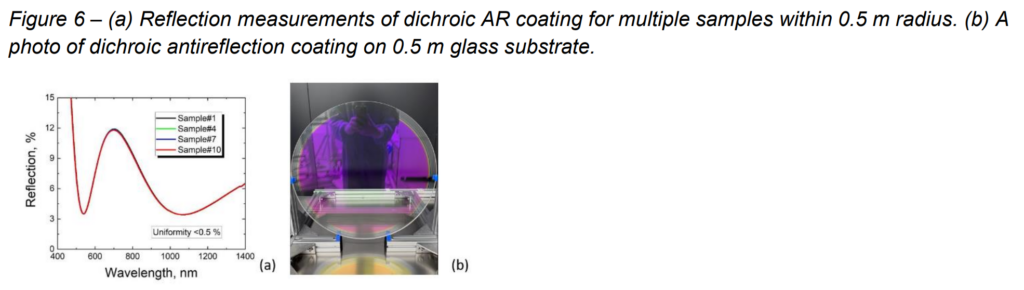
Using the ELIAS coating system, the team manufactured metallic mirrors and dielectric coatings for optical components exceeding one metre in size, achieving coating uniformity better than 0.5% across a 1.2-metre substrate plane.
Gold-coated mirrors were successfully installed in the L4 beam transport system and operated with laser pulses reaching approximately 5.1 PW peak power without observed damage.
Further developments included anti-reflection coatings with reflectivity below 0.1% and high-reflection coatings with improved laser-induced damage thresholds of up to 84.8 J/cm².
These achievements demonstrate the potential to manufacture large-area, high-performance optical components for future kilojoule- and petawatt-class laser facilities, helping to address a major technological bottleneck.
Explore the latest THRILL results
Together, these four deliverables demonstrate progress across several complementary technologies, from faster laser amplification and more stable beam control to advanced optical components capable of handling extreme laser intensities.
All reports and further information are available on the THRILL deliverables page.
