

We are happy to share that a new research paper has been published:
Patch-MLP-based predictive control: simulation of upstream pointing stabilization for PHELIX laser system
Jiaying Wang, Jonas Benjamin Ohland, Yen-Yu Chang, Vedhas Pandit, Stefan Bock, Andrew-Hiroaki Okukura, Udo Eisenbarth, Arie Irman, Michael Bussmann, Ulrich Schramm
Mach. Learn.: Sci. Technol. 7 015023 (2026)
https://doi.org/10.1088/2632-2153/ae393d
Abstract:
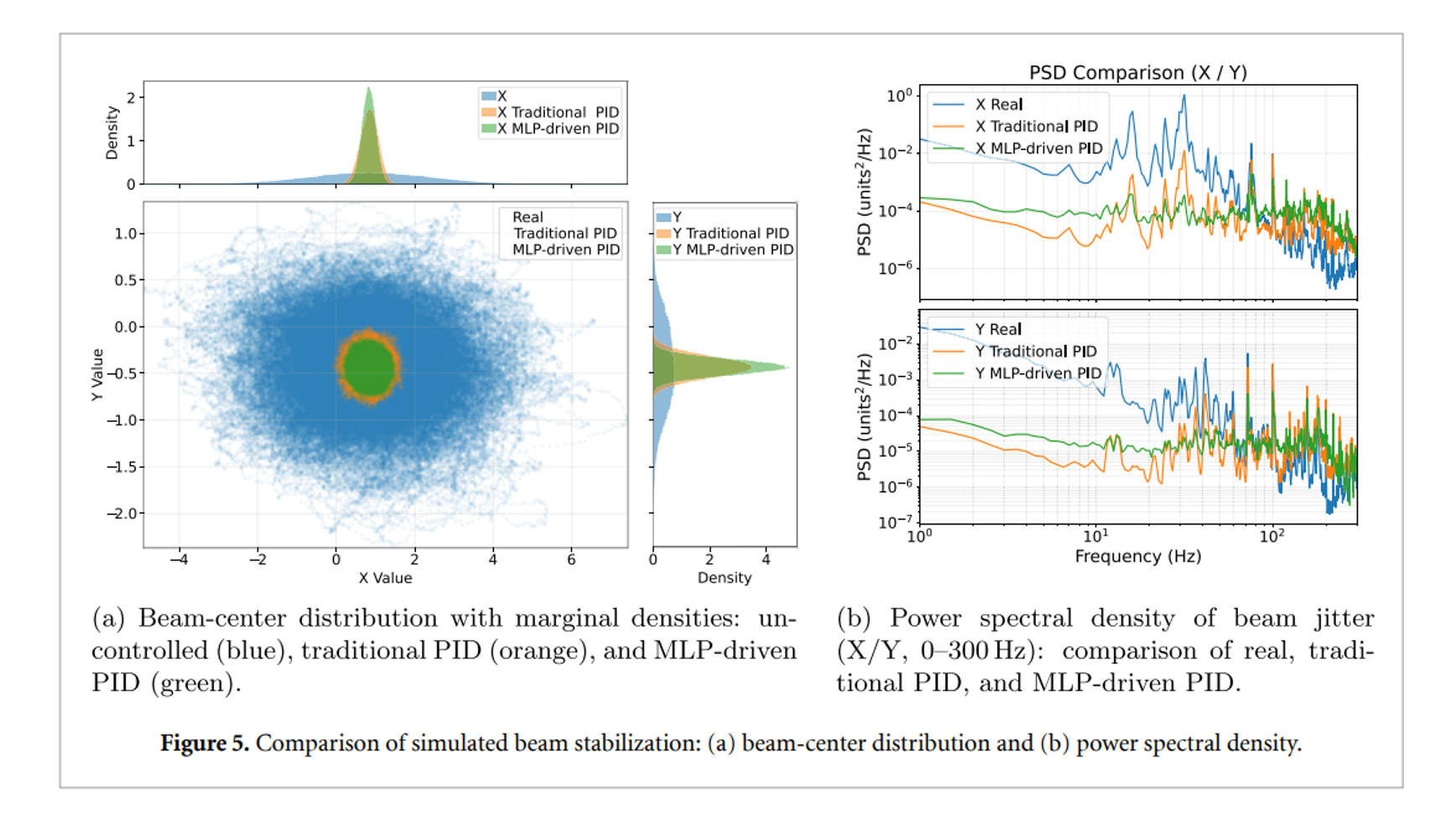
High-energy laser facilities such as PHELIX at GSI require excellent beam pointing stability for reproducibility and relative independence for future experiments. Beam pointing stability has been traditionally achieved using simple proportional-integral-derivative (PID) control which removes the problem of slow drift, but is limited because of the time delay in knowing the diagnosis and the inertia in the mechanical system associated with mirrors. In this work, we introduce a predictive control strategy where the forecasting of beam pointing errors is performed by a patch-based multilayer perceptron designed to capture local temporal patterns for more robust short-term jitter prediction. The subsequent conversion of these predicted errors into correction signals is handled by a PID controller. The neural network has been trained on diagnostic time-series data to predict beam pointing error. Using the hybrid predictive-feedback controller compensates for system delays. Simulations with a correction mirror placed upstream of the PHELIX pre-amplifier bridge confirm that the predictive control scheme reduces residual jitter compared to conventional PID control. In our simulations, over a 10 h dataset the controller maintained stable performance without drift, while standard pointing metrics showed consistent improvements of the order of 10%-20%. The predictive controller operates without drift, and therefore may improve reproducibility and operational efficiency in high energy, low repetition rate laser experiment conditions.
(Image from Jiaying Wang et al 2026 Mach. Learn.: Sci. Technol. 7 015023, used under Creative Commons license https://creativecommons.org/licenses/by/4.0/)
