


It’s time to look back on our achievements and highlights from the second year of the THRILL project!
As we enter the third year of our project, we can report some great results in the last 12 months, from promising tests and experiments to two new publications and a successful summer school in October. All work packages are fully operational and making valuable contributions towards the objectives of the project:
High-energy high-repetition-rate amplification
- AMPLITUDE achieved the assembly of the first 200-mm Pseudo-Active Mirror Amplification Module (PAMDAM) during summer. Cooling circuit and flashlamp discharge test has been performed for 20,000 shots at the rate of 1 shot/20 sec without misfire or broken lamps. Two different cooling fluids have endured a series of tests. First, the laser irradiation damage threshold had been measured above 400 MW/cm2 and 1 GW/cm2 for the two cases, respectively. Transmission of the whole optical assembly has been measured for both fluids, up to 96% for fluid n°1. Finally, the test of flashlamp irradiation (intense incoherent white light) degraded fluid n°1 and not fluid n°2, making fluid n°2 the fluid of choice for further measurement.
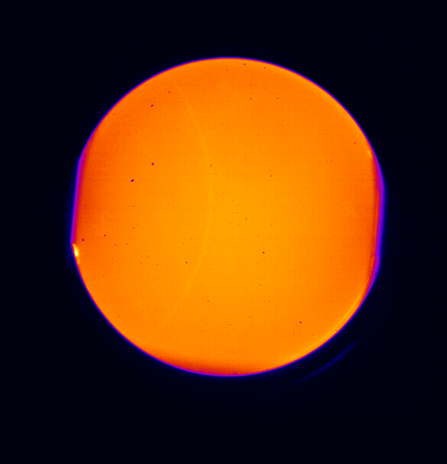
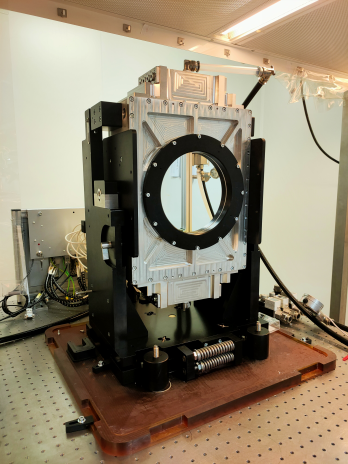
- The ELI beamlines laser team completed the characterization of both main power amplifier chains PA1 and PA2 of the ATON Laser, under different coolant flow speeds as well as different repetition rates. Static and dynamic errors were clearly identified. The wavefront improvement after the upgrade of the deformable mirror membrane was reported too. The report called “Report on the characterization of ATON laser amplifier” summarizes the main results.
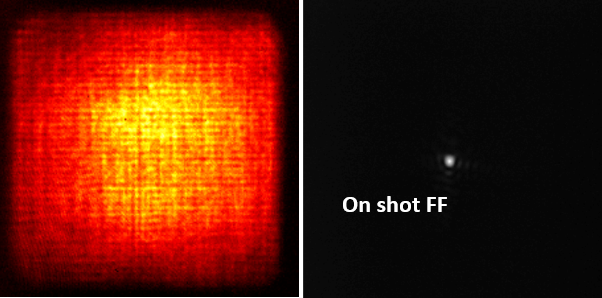
- GSI performed full-size tests of a cooled-flash-lamp amplifier module in real operation conditions. The results show a significant shortening in the cool-down time by a factor greater than 5, compared to the standard case. The opens the route to an upgrade of PHELIX within the next years towards a 1 shot/10 min repetition rate.
High-energy beam transport
- In February, the Apollon Real Time Adaptive Optics (ARTAO) system has been tested within the Apollon beamline. This demonstrated outstandingbeam stability with a constant Strehl ratio of more than 0.96, promising an unprecedented reliability in shot delivery. These results have been published and already catalyzed several international collaborations, focusing on integrating real-time adaptive optics into practical laser operations.
- The Subaru Coronagraphic Extreme Adaptive Optics (SCExAO) team (Hawaii, USA) played a pivotal role, sharing their expertise in transferring adaptive optics technology from cutting-edge astronomy to high-power laser systems. This successful cross-disciplinary effort paves the way for more robust laser systems, potentially revolutionizing applications in fields such as experimental physics and laser fusion. (LULI/Apollon)
Optical coating resilience for large optics
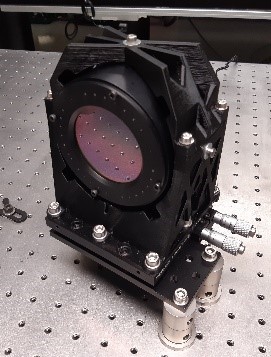
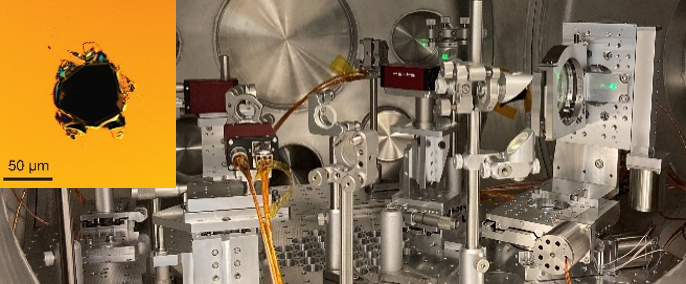
- The ELI Beamlines team completed the upgrade to its Laser-Induced Damage Testing (LIDT) station. The ultrafast high-vacuum setup was redesigned to support a higher number of samples from the coating development program within the ELIAS laboratory. The optomechanics supports up to 3’’ samples or several smaller ones. Most of the subsystems were upgraded too, namely actuators, vacuum cameras or controls. A high resolution wavefront detector was integrated into the setup to considerably improve sensitivity. Several grating LIDT test campaigns were performed followed by tests of the first ELIAS coating chamber samples.
Large area coatings
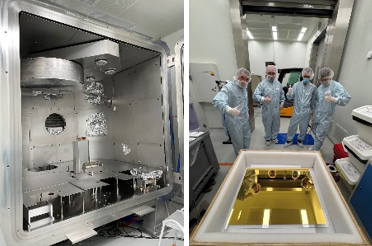
- The ELI beamlines coating team made progress in expanding the capabilities for large optics development using an evaporation process. Commissioning of the Advanced ELI deposition System (ELIAS) has been successfully achieved, after the installation of the prototype plasma ion source. A multilayer gold mirror coating has been developed and tested in ultrafast laser systems. So far, up to one-meter-scale mirrors could be coated and their spectral uniformity confirmed.
Simulation software development
- The team at GSI has released 4 new versions of its simulation framework “OPOSSUM”. The latest version (v0.6.0) includes several new functionalities like automated ghost focus analysis and the treatment of laser-induced damage thresholds. Additionally, the catalogue of the treated optical components now includes non-paraxial components like diffraction gratings and off-axis parabolas.

Coherent beam combining
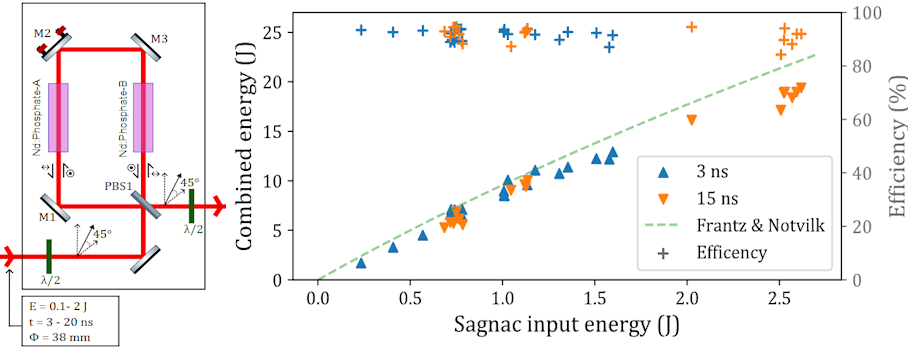
- LULI is exploring the possibility of using the coherent beam combining (CBC) of high-energy nanosecond beams. The parallel use of several small amplifiers can overcome the technological constraints and low repetition rates imposed by large amplifiers. First results have been obtained with a Sagnac interferometer architecture for combining beams of up to 20 J. Experiments to characterize the dynamics of aberrations introduced by flash-pumping are underway, with a view to moving towards active CBC a more scalable approach.
Community building and training
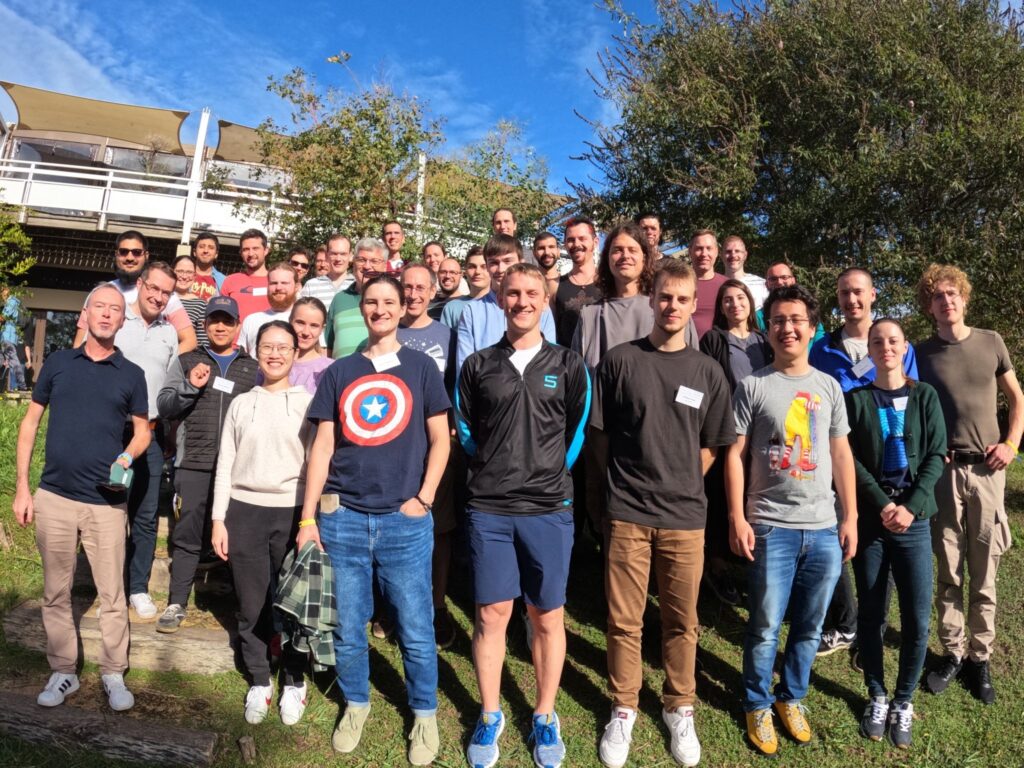
- From 7-11 October, 30 students from eight European countries have participated in the first THRILL summer school in the south of France. The curriculum spanned key topics essential to the THRILL project, from laser amplification, optical coatings, beam quality and artificial intelligence in the context of modern high-energy laser facilities. The heuristic lectures were enriched by small-group, directed work and practical sessions for in-depth hands-on training. The next THRILL summer school will take place in June 2026 in Austria.
- In addition to the immediate training of researchers within the topics of their work packages, several short-term staff exchanges between the participants in the project took place to ensure that researchers develop an understanding of all techniques available at other facilities and learn about each other’s expertise.
We look forward to the third year of our project to continue to work on advancing technology in the field of high-energy high-repetition-rate lasers and train a highly skilled workforce for tomorrow’s challenges in research infrastructures and industry!
Subscribe to our newsletter and follow us on LinkedIn to learn more about our work at THRILL, and stay updated on our advances!
